Hose Twist: Why It Destroys Hydraulic Hoses and How Swivel Fittings Prevent It
A twisted hose fails early, often at the fitting. Learn how twist happens during installation, how to spot it in seconds, and which swivel fittings keep hoses straight.
Ask any hose assembler what kills hoses early and "twist" will be near the top of the list. A hose that is twisted during installation looks fine on the machine, holds pressure on the first test and then fails months before it should, usually right behind the fitting. The good news: twist is entirely preventable with the right fittings and a few minutes of care.
Why twist damages a hose
A hydraulic hose is built from layers of wire braid or spiral wound at precise angles. Under pressure, those wires share the load evenly. When a hose is twisted, the wires in one direction are tightened and the wires in the other are loosened. The result:
- Uneven load on the reinforcement, so some wires carry far more than their share at every pressure pulse.
- Stress concentrated at the fitting, where the hose cannot rotate.
- Cover and tube damage, as layers shear against each other.
- Loosened connections, because a twisted hose constantly tries to unwind and can back off a nut.
Industry guidance such as SAE J1273 (hose selection, installation and maintenance practices) warns specifically against twisting hoses during installation, because even a small twist sharply reduces impulse life.
How hoses get twisted
- Tightening the hose nut without holding the fitting body, so the whole hose turns with the spanner.
- Rigid male fittings at both ends: after the first end is fitted, the only way to thread in the second end is to rotate the hose.
- Poor routing: a hose that bends in two planes tends to twist when the machine moves.
- Moving parts: on cylinders or rotating joints, motion twists the hose if the routing does not allow for it.
Spot it in seconds: check the lay line
Almost every hydraulic hose has a printed lay line running along its length (brand, size, standard, date). After installation, the lay line should run straight. If it spirals around the hose, the hose is twisted. Make this a standard check for every new or replaced assembly.
Swivel fittings: the simple fix
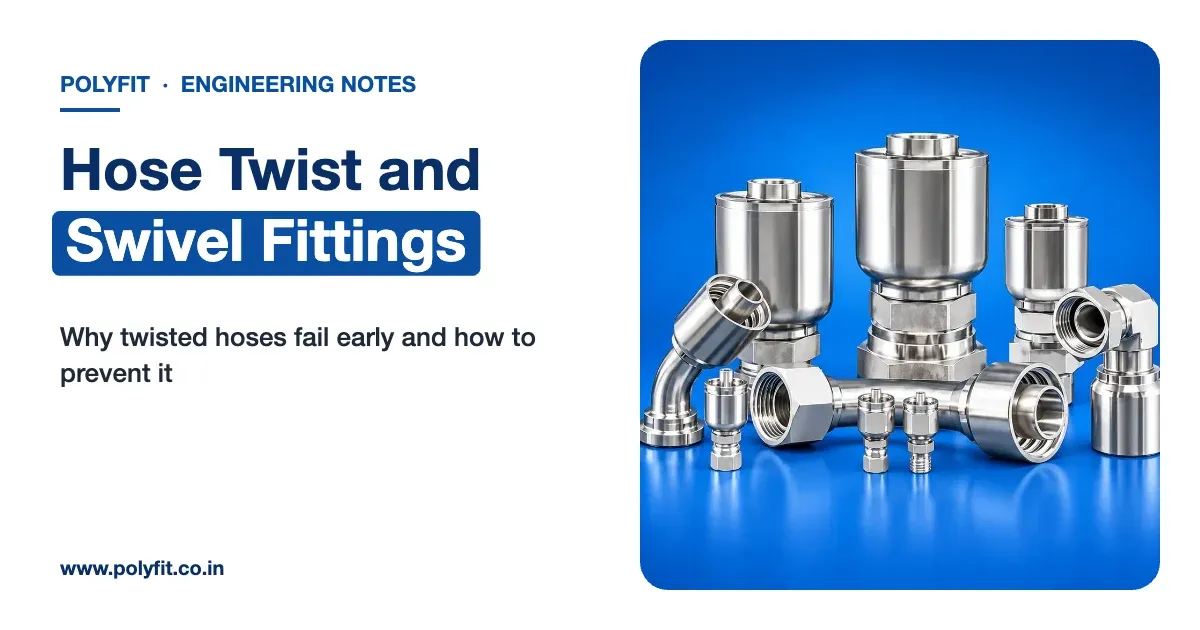
Swivel fittings let the connection be tightened without turning the hose. The main types:
Swivel type | How it works | Typical use |
|---|---|---|
Female swivel nut (JIC, ORFS, BSP, metric) | Nut rotates freely on the fitting; the seat stays still | Most hose ends. The nut is tightened while the hose stays in position |
Swivel male | Male thread rotates relative to the hose fitting | Ports where a rigid male would force the hose to rotate |
Double hex / back-up hex | Second hex on the body for a holding spanner | Holding the fitting steady while the nut is tightened |
Live swivel joint | Bearing-type joint that rotates under pressure | Rotating equipment, reels, booms, continuous movement |
Swivel adapter | Adapter with one swivel end | Fixing orientation of elbows at ports |
A common example is the NPT swivel male. NPT is a tapered thread that must be screwed into a port, so with a rigid NPT male the hose has to turn with the thread. A swivel male lets the thread be driven home while the hose stays put. Polyfit manufactures an NPT swivel male two-piece fitting and a double hexagonal NPSM female swivel one-piece fitting for exactly this reason.
Installation checklist to prevent twist
- Plan the ends. Make sure at least one end of every assembly is a swivel, or use an adapter to add one.
- Orient elbows before crimping. If an assembly has elbows at both ends, specify the orientation angle between them when ordering, so the hose does not need to be twisted to fit.
- Fit the first end finger tight, route the hose, then fit the second end finger tight.
- Hold the body, turn the nut. Use two spanners: one on the back-up hex or fitting body, one on the nut.
- Tighten to the maker's torque or flats. See the tightening steps in our JIC fittings guide.
- Check the lay line before and after pressurising.
- Cycle the machine and watch the hose through its full movement. It should flex in one plane without twisting.
Routing tips that prevent twist
- Bend hoses in one plane only. If a hose must bend in two planes, split it with a fixed elbow or clamp.
- Respect the minimum bend radius from the hose data sheet. See how to read a hydraulic hose spec table.
- Allow slack for length change: a hose shortens slightly under pressure (and some hoses lengthen).
- Use clamps to hold hoses, but never so tight that they twist or crush the hose.
When the fittings are the problem
If hoses on a machine keep failing at the fitting with spiralled lay lines, the design itself may be at fault, for example rigid male ends at both sides, or elbows crimped at the wrong orientation. Changing to swivel fittings, or adding a swivel or elbow adapter, often solves the problem permanently.
Polyfit manufactures fittings with female swivel nuts in BSP, JIC, ORFS and metric, swivel male fittings and adapters, and supplies complete hose assemblies with elbows crimped at the orientation you specify. Send us your drawing or an old assembly through Request a quote.
From precision components to custom manufacturing, Polyfit delivers solutions tailored to your application and specifications.
Request a quote