Hydraulic Fittings Manufacturers in India: A Buyer’s Checklist for Choosing a Supplier
Price per piece is the smallest part of the cost of a hydraulic fitting. This checklist shows procurement and engineering teams what to verify before approving a fittings manufacturer in India.
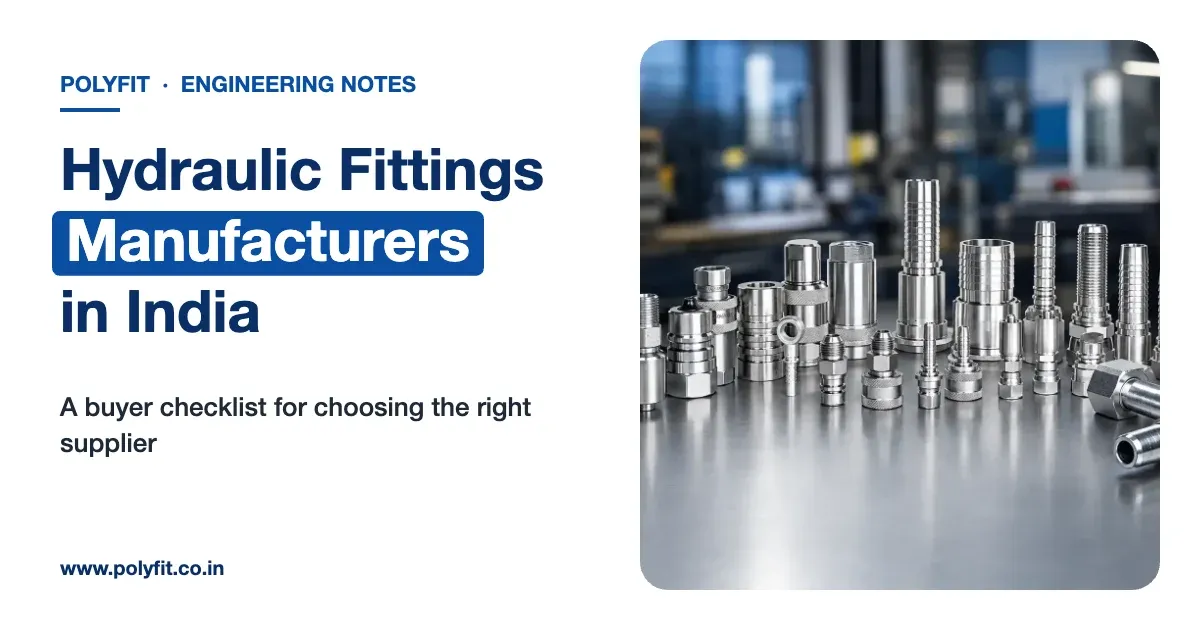
India has hundreds of hydraulic fittings suppliers, from small machine shops to integrated manufacturers exporting worldwide. On a quotation they can look identical. In service they are not: a leaking or blown fitting costs far more in downtime, oil, warranty and safety than the fitting itself. Whether you are an OEM approving a new source, a hose assembler or a maintenance buyer, this checklist will help you separate a reliable manufacturer from a trader.
1. Manufacturer or trader?
Ask where the parts are machined, crimped, plated and tested. A true manufacturer controls dimensions, material and plating in-house, can change a design for you and can trace any batch. A trader may offer a wider catalogue but cannot always answer engineering questions or guarantee consistency between lots.
Ask for: a plant visit or video tour, a list of machines (CNC turning, forging, plating, crimping, test rigs), and production capacity per month.
2. Standards the fittings are made to
Genuine hydraulic fittings are designed and dimensioned to recognised standards. The most important:
Standard | What it covers |
|---|---|
ISO 12151 | Hose fittings with ISO 8434 and ISO 6149 ends |
SAE J516 | Hydraulic hose fittings |
ISO 8434-1 / DIN 2353 | 24° cone tube fittings |
ISO 8434-2 / SAE J514 | 37° flare (JIC) fittings |
ISO 8434-3 / SAE J1453 | O-ring face seal (ORFS) fittings |
ISO 228-1 / ISO 7-1 | BSP parallel and taper threads |
ISO 6162 | SAE Code 61 / 62 flange connections |
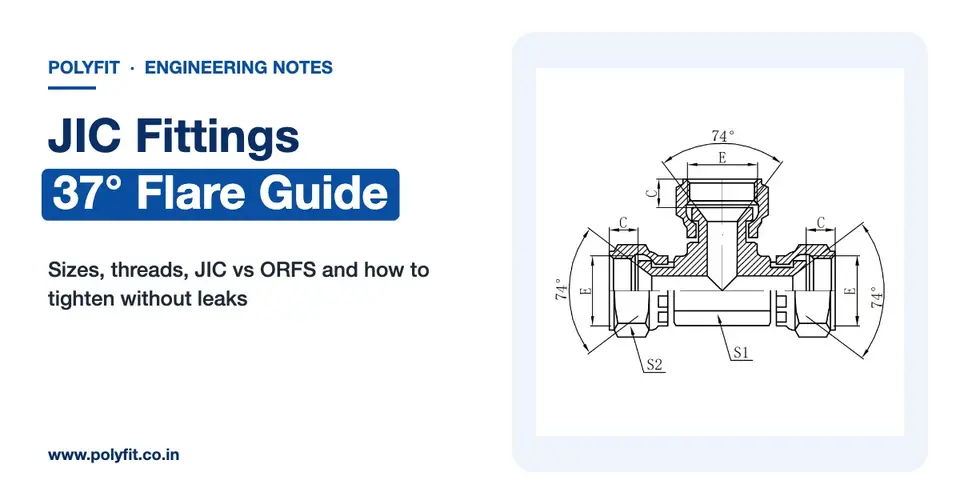
A supplier who can tell you which standard each part follows, and supply drawings with tolerances, is a supplier who controls quality. Our thread size chart and JIC fittings guide explain several of these standards.
3. Material and traceability
- Carbon steel fittings should be made from free-machining or forging grades with consistent chemistry.
- Stainless steel (usually AISI 316) for marine, chemical, food and offshore service.
- Brass for low-pressure, instrumentation and some fuel applications.
Ask for: mill test certificates (for example EN 10204 3.1) and a heat or batch number on packing, so a failure can be traced back to its material.
4. Plating and corrosion resistance
The plating decides how a fitting looks after a monsoon season on a construction site. Trivalent zinc and zinc-nickel platings are common in modern hydraulics.
Ask for: neutral salt spray test results (ISO 9227) in hours to white and red rust, and the plating thickness specification.
5. Testing: proof, burst and impulse
- Proof test: critical assemblies pressurised above working pressure before dispatch.
- Burst test: samples taken to failure to confirm the safety factor (commonly 4:1 for hose assemblies).
- Impulse test: fittings and hose cycled at high pressure (to ISO 6803), the best predictor of service life.
Ask for: test reports for the hose and fitting combination you will use, not just the fitting alone.
6. Crimp data and technical support
For hose fittings, the manufacturer must provide crimp diameters for each hose, and state whether skiving is needed. Without this, even a perfect fitting can fail. See skived vs non-skived hose fittings and one-piece vs two-piece hose fittings.
Ask for: a crimp chart, insertion depths, and help selecting the right fitting for a new hose.
7. Certifications
- ISO 9001 quality management as a minimum.
- IATF 16949 if you supply the automotive industry.
- Welding and fabrication certifications (such as EN ISO 3834 and EN 1090) if fittings are part of welded or fabricated assemblies.
- Export status and experience shipping to your target market.
8. Range, customisation and lead time
A good fittings partner covers the families you use today, such as BSP, JIC, NPT, ORFS, metric, SAE flange, adapters and quick couplings, and can make specials to drawing. Ask for standard lead times, safety stock options and how urgent breakdown orders are handled.
9. Total cost, not unit price
Compare suppliers on total cost of ownership: unit price, rejection rate, delivery reliability, stock you must carry, and the cost of a single field failure. A fitting that costs 10% less but leaks once on a customer's machine is the most expensive fitting you will buy.
Supplier evaluation checklist
Check | What good looks like |
|---|---|
Manufacturing | In-house machining, plating control, crimping and testing |
Standards | Parts drawn to ISO / SAE standards with tolerances |
Traceability | Material certificates and batch marking |
Corrosion | Salt spray results to ISO 9227 |
Testing | Proof, burst and impulse data for your combination |
Technical data | Crimp charts, skive data, selection help |
Certification | ISO 9001, IATF 16949 where relevant |
Range | All families you use, plus specials to drawing |
Service | Clear lead times, breakdown support, local contact |
About Polyfit
Polyfit has manufactured hydraulic products in Chennai, Tamil Nadu, since 1978, and has been recognised as a One Star Export House. Our range includes two-piece hose fittings, one-piece 43 series fittings, hydraulic adapters, quick release couplings, SAE flange fittings, tube fittings and complete hydraulic hose assemblies. Our quality certificates are available on the Downloads page.
To evaluate Polyfit as a supplier, send your drawings, part numbers or annual requirement through Request a quote, or contact our team to arrange a plant visit.
From precision components to custom manufacturing, Polyfit delivers solutions tailored to your application and specifications.
Request a quote