One-Piece vs Two-Piece Hydraulic Hose Fittings: Which Should You Use?
One-piece fittings are fast and foolproof; two-piece fittings are flexible and built for the toughest hoses. A side-by-side comparison with a hose-by-hose selection table.
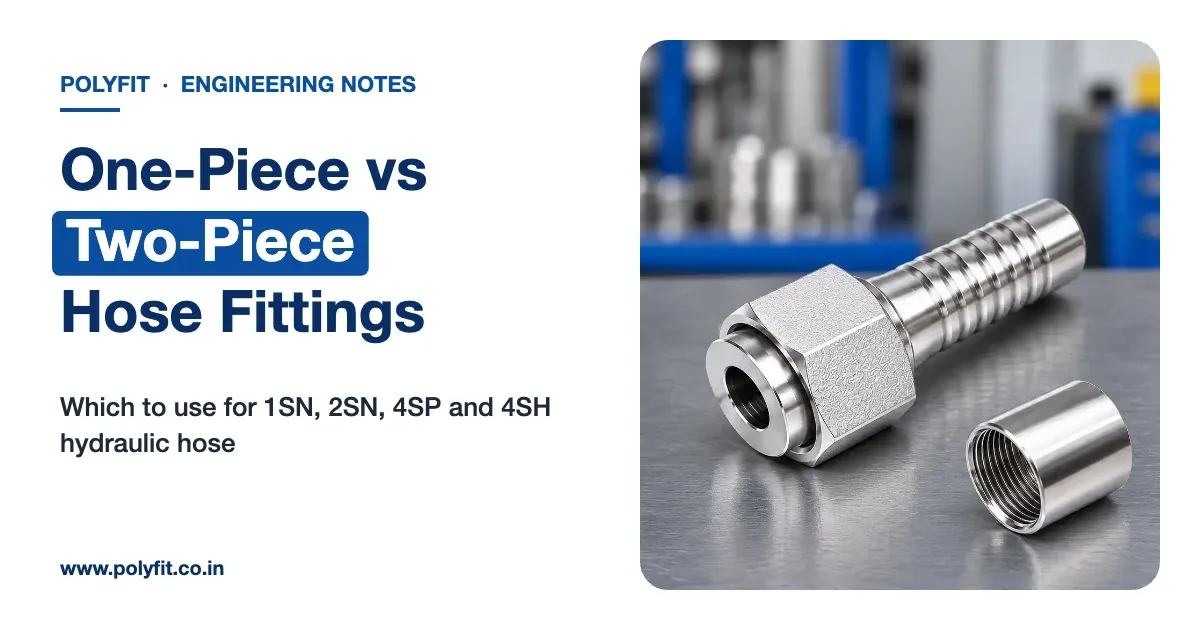
Every crimped hydraulic hose assembly has two metal parts at each end: an insert (also called a stem, nipple or tail) that goes inside the hose and carries the thread or flange, and a ferrule (socket or shell) that is crimped around the outside of the hose. The question is whether those two parts come joined or separate. That single difference affects how fast you can build assemblies, which hoses you can use, how much stock you carry and how likely a crimp mistake is.
What is a one-piece hose fitting?
In a one-piece fitting, the ferrule is permanently attached to the insert at the factory, usually by a small pre-crimp or collar. You push the hose in, crimp, and the assembly is done.
Advantages
- Faster assembly. One part to pick, one part to load in the crimper.
- Fewer mistakes. The ferrule cannot be mismatched with the wrong insert or fitted the wrong way round.
- Consistent alignment. The ferrule is held concentric with the insert, which gives an even crimp.
- Simpler stock. One part number per end configuration.
Limitations
- Each fitting is designed for a specific hose family and size, typically wire-braided hoses such as SAE 100R1/EN 853 1SN and SAE 100R2/EN 853 2SN, and many are designed for no-skive hoses.
- Less flexibility if you change hose brands or construction.
Polyfit's 43 series one-piece fittings cover BSP, JIC and NPT/NPSM ends.
What is a two-piece hose fitting?
In a two-piece fitting, the insert and ferrule are separate parts chosen to match each other and the hose. They are assembled at the crimping bench.
Advantages
- Wider hose range. The same insert can be paired with different ferrules for 1SN, 2SN, 4SP, 4SH, R12, R13, R15, thermoplastic or PTFE hose.
- Built for high pressure. Multi-spiral hoses (4SP, 4SH, R13, R15) usually need two-piece fittings, often with interlock ferrules that lock mechanically into the insert to resist blow-off under pressure impulses.
- Inventory efficiency for large users. You stock a smaller range of ferrules and combine them with many insert end styles.
- Material choice. Inserts and ferrules can be specified in different materials or platings for corrosive environments.
Limitations
- More parts to track and more opportunity to mismatch ferrule, insert and hose.
- Some combinations require skiving (removing the hose cover). See skived vs non-skived hose fittings.
- Slightly slower assembly.
Polyfit's two-piece fittings are available in BSP, JIC, NPT, ORFS, metric L and S and SAE flange ends, with matching ferrules.
Side-by-side comparison
One-piece fitting | Two-piece fitting | |
|---|---|---|
Parts per hose end | 1 | 2 (insert + ferrule) |
Typical hoses | 1SN/R1, 2SN/R2, some thermoplastic | All, including 4SP, 4SH, R12, R13, R15, PTFE |
Pressure capability | Low to high (braided hose range) | Up to the highest multi-spiral pressures |
Skiving | Usually not required | Required for some hose/ferrule combinations |
Assembly speed | Fastest | Slower |
Risk of mismatch | Very low | Higher, needs good training |
Inventory | More part numbers, simple logic | Fewer ferrules, more combinations |
Best for | Production lines, service vans, standard machines | High pressure, impulse, large or mixed hose ranges |
Which fitting for which hose?
Hose | Construction | Usual choice |
|---|---|---|
EN 853 1SN / SAE 100R1AT | 1 wire braid | One-piece or two-piece with 1SN ferrule |
EN 853 2SN / SAE 100R2AT | 2 wire braids | One-piece or two-piece with 2SN ferrule |
EN 856 4SP | 4 wire spirals | Two-piece with 4SP ferrule |
EN 856 4SH, SAE 100R12 | 4 heavy spirals | Two-piece with 4SH/R12 ferrule, often interlock |
SAE 100R13, R15 | 4 to 6 spirals | Two-piece interlock |
SAE 100R7, R8 thermoplastic | Fibre braid |
Always confirm with the fitting maker's crimp chart. A hose and fitting combination is only as good as the crimp diameter used. If you are unsure how to read hose ratings, see how to read a hydraulic hose spec table.
Cost: which is cheaper?
Per piece, a one-piece fitting usually costs about the same as an insert plus ferrule. The real cost difference is in labour and errors. In a high-volume assembly shop, one-piece fittings cut handling time and almost eliminate mismatched parts. In a workshop that builds many different hose types, two-piece fittings mean fewer ferrule part numbers and less capital tied up in stock.
Common mistakes
- Mixing brands. A ferrule from one maker and an insert from another may look identical but have different crimp diameters. The assembly may pass a visual check and fail in service.
- Using a braided-hose ferrule on spiral hose. The ferrule is too short and too thin to hold a 4SH hose under impulse.
- Skipping the skive when the fitting requires it, or skiving when it does not.
- Re-using ferrules. Crimped ferrules are single-use.
How to choose
Choose one-piece for standard braided hose assemblies, OEM production, service vehicles and anywhere speed and simplicity matter most. Choose two-piece for multi-spiral high-pressure hose, impulse-heavy applications such as excavators and presses, corrosive environments that need special materials, or when you assemble many different hose types.
Polyfit manufactures both in Chennai and supplies OEMs and hose assemblers across India and overseas. Tell us your hose type, size, working pressure and end connections through Request a quote, and our engineers will recommend the right combination.
From precision components to custom manufacturing, Polyfit delivers solutions tailored to your application and specifications.
Request a quote