Skived vs Non-Skived Hydraulic Hose Fittings: When to Skive and Why It Matters
Skiving removes rubber from the hose end so the ferrule grips the wire. Done right, it holds the highest pressures; done wrong, it causes leaks and blow-offs. Here is when to skive and when not to.
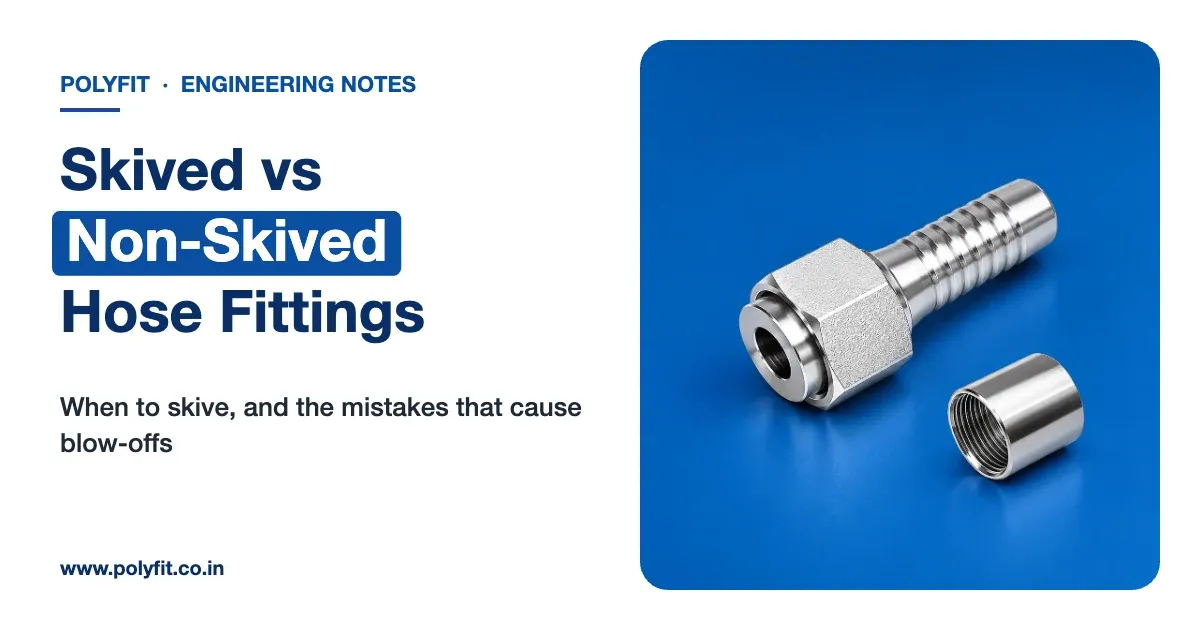
If you build hose assemblies for excavators, presses or test rigs, sooner or later you will meet a fitting that says "skive required". Skiving is a small step in the assembly process, but get it wrong and the hose can blow off its fitting under pressure. This guide explains what skiving is, which hoses need it, how to do it correctly and why most modern braided hoses no longer need it.
What does "skiving" a hose mean?
Skiving means removing a precise length of rubber from the end of the hose before fitting the ferrule and insert:
- External skive: the outer rubber cover is removed, exposing the wire reinforcement. The ferrule teeth then bite directly onto the wire.
- Internal skive: part of the inner tube is removed so the insert sits closer to the wire. This is mainly used on some very high-pressure, multi-spiral hoses.
- Double skive: both external and internal skives on the same hose end.
The aim is a metal-to-metal grip: ferrule on wire, wire on insert, with no thick rubber layer in between that could creep or extrude under pressure pulses.
What is a non-skive fitting?
A non-skive (no-skive) fitting is designed to be crimped straight over the hose cover. Its ferrule has deeper, sharper teeth that penetrate the cover and grip the wire during crimping. Hose manufacturers developed thinner, tougher covers to make this reliable. Today, most EN 853 1SN and 2SN braided hoses, and many EN 856 4SP hoses, are designed for no-skive fittings.
Skive vs no-skive at a glance
Skive fittings | Non-skive fittings | |
|---|---|---|
Hose preparation | Cover (and sometimes inner tube) removed | Cut and clean only |
Grip | Directly on wire reinforcement | Teeth bite through cover onto wire |
Typical hoses | Multi-spiral 4SH, R12, R13, R15, some 4SP | 1SN, 2SN, most 4SP, many thermoplastics |
Pressure range | Highest working and impulse pressures | Low to high |
Assembly time | Longer, needs skiving tool | Faster |
Main risks | Over- or under-skive, exposed wire corrosion | Wrong ferrule for hose cover thickness |
Tooling | Skiving machine or hand tool with gauge | Cut-off saw and crimper |
Which hoses usually need skiving?
As a general guide (always follow the hose and fitting maker's chart):
- EN 853 1SN / 2SN (wire braid): normally no-skive.
- EN 856 4SP (4 spiral): normally no-skive in smaller sizes; some larger sizes and some fitting designs require skiving.
- EN 856 4SH and SAE 100R12: often skived, usually with interlock ferrules.
- SAE 100R13 and R15 (up to about 5,000 to 6,000 psi working pressure): typically skived and interlocked.
Interlock fittings have a ferrule that mechanically locks into a groove on the insert, so the insert cannot be pushed out of the hose by pressure impulses. They are usually paired with skiving on heavy multi-spiral hoses.
How to skive correctly
- Use the right skive length. The skive length is set by the ferrule, not by eye. Use the length in the fitting maker's chart, usually set with a stop on the skiving tool.
- Remove the cover only. The wires should be clean and bright, with no rubber left on them and no cut or nicked wires.
- Do not skive too long. Exposed wire beyond the ferrule will rust and is unprotected from abrasion.
- Do not skive too short. If the ferrule overlaps uncut cover, its teeth will not seat correctly and grip will be lost.
- Clean the hose end. Blow out all rubber particles before inserting the fitting, as they contaminate the hydraulic system.
- Mark the insertion depth and check that the hose is fully pushed home before crimping.
- Crimp to the specified diameter and measure the crimp with a caliper after crimping.
What goes wrong: common failures
- Blow-off at the fitting: usually a skive fitting used without skiving, an under-skive, or the wrong crimp diameter.
- Leaking at the ferrule: rubber left on the wires or a damaged inner tube.
- Rusty, broken wires just outside the ferrule: over-skiving, leaving exposed wire.
- Mixed systems: a no-skive ferrule used on a skived hose, so the ferrule teeth cannot grip the bare wire properly.
The single most important rule: never mix skive and no-skive components, and never mix ferrules, inserts and hoses from different systems without the maker's approval. If you want to understand the difference between ferrule types, read one-piece vs two-piece hose fittings.
How to inspect a finished assembly
- Measure the crimp diameter at several points; it must be within the specified tolerance.
- Check that the ferrule sits evenly and the hose has not moved back from the insertion mark.
- For skived hose, check that no bare wire is visible beyond the ferrule.
- Pressure-test critical assemblies at the specified proof pressure before dispatch.
Skive or no-skive: which should you choose?
For most medium-pressure machinery built on 1SN, 2SN and 4SP hose, no-skive systems are faster and remove a whole source of assembly error. For the highest pressures and severe impulse duty, such as 4SH, R13 and R15 hose on excavators, presses and mining equipment, skived interlock fittings remain the most secure choice.
Polyfit manufactures two-piece hose fittings and ferrules for braided and multi-spiral hoses, and builds complete hydraulic hose assemblies crimped and tested in our own plant. Tell us your hose and pressure, and we will specify the right fitting, skive and crimp. Request a quote.
From precision components to custom manufacturing, Polyfit delivers solutions tailored to your application and specifications.
Request a quote