JIC Fittings: The Complete Guide to 37° Flare Hydraulic Fittings
JIC 37° flare fittings are the most widely used hydraulic connection in the world. Here is how they seal, how to read their sizes, how they compare with SAE 45° and ORFS, and how to install them without leaks.
JIC fittings are the "universal language" of hydraulic plumbing. Walk through any plant, mobile machine or test bench and you will find 37° flare connections on hoses, tubes and adapters. They are popular because they are simple, reusable, available in every size and interchangeable between manufacturers. This guide explains how JIC fittings work, how to identify them, how to choose sizes, and where a different connection may serve you better.
What is a JIC fitting?
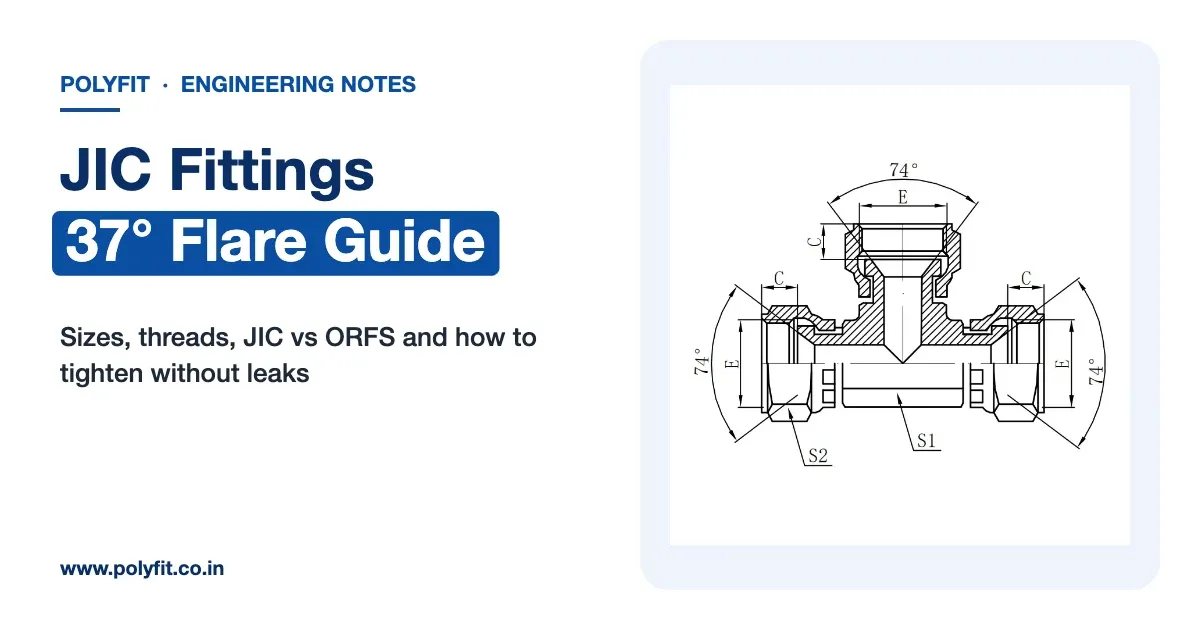
JIC stands for Joint Industry Council, the American body that first standardised this fitting. Today it is defined by SAE J514 and internationally by ISO 8434-2. A JIC fitting seals metal to metal on a 37° flared seat: the male fitting has a 37° cone (the "nose"), and the female fitting or swivel nut carries a matching 37° seat. When the nut is tightened, the two cones are pressed together and form the seal. The threads only hold the joint together; they do not seal.
You will often see the female end described as "JIC female 74° cone seat". That is the same thing: 74° is the included angle of the cone (37° each side of the centre line). Our two-piece JIC fittings use this description in their product names.
Why JIC fittings are so widely used
- Reusable. The metal seat can be connected and disconnected several times, as long as it is not over-tightened or damaged.
- No O-ring to lose or swell. The seal is purely metal to metal, so there is no elastomer to select for temperature or fluid compatibility.
- Wide pressure range. Depending on size, JIC connections are commonly used up to around 5,000 psi (345 bar) in small sizes, with ratings falling as the size increases.
- Global availability. Almost every hose and adapter maker supplies JIC ends, which makes spares easy to source.
- Works for hose and tube. The same 37° flare is used on flared steel tube, so hose assemblies and rigid tubing connect directly.
JIC size and thread chart
JIC fittings use UNF/UN straight threads and are sized with dash numbers. The dash number is the tube OD in sixteenths of an inch: -8 means 8/16" = 1/2" tube. The thread, however, is larger than the tube, which is why people often mismeasure them.
Dash size | Tube OD (inch) | Thread (UNF) | Thread OD approx. (mm) |
|---|---|---|---|
-4 | 1/4 | 7/16-20 | 11.1 |
-5 | 5/16 | 1/2-20 | 12.7 |
-6 | 3/8 | 9/16-18 | 14.3 |
-8 | 1/2 | 3/4-16 | 19.0 |
-10 | 5/8 | 7/8-14 | 22.2 |
-12 | 3/4 | 1 1/16-12 | 27.0 |
-14 | 7/8 | 1 3/16-12 | 30.2 |
-16 | 1 | 1 5/16-12 | 33.3 |
-20 | 1 1/4 | 1 5/8-12 | 41.3 |
-24 | 1 1/2 | 1 7/8-12 | 47.6 |
-32 | 2 | 2 1/2-12 | 63.5 |
For the threads of BSP, NPT, ORFS and metric fittings side by side, see our hydraulic fitting thread size chart.
How to identify a JIC fitting in three checks
- Look at the seat. A JIC male has a cone on the nose. A female JIC has a matching cone inside the swivel nut. If you see a flat face with an O-ring, it is ORFS; if you see an O-ring on the thread shoulder, it is SAE O-ring boss.
- Measure the seat angle. Use a seat angle gauge. 37° means JIC. 45° means SAE flare (common in automotive and refrigeration), and 24° indicates a metric DIN cone.
- Measure the thread. Use a vernier caliper on the thread OD and a pitch gauge for threads per inch. Compare with the chart above. A 3/4-16 thread with a 37° cone is a -8 JIC.
Our article on types of hydraulic hose fittings walks through identification for every common family.
JIC vs SAE 45° flare
The two look almost identical and some sizes even share the same thread, so they are frequently mixed up. They are not interchangeable. A 37° fitting screwed onto a 45° seat makes contact on a thin line instead of a full cone, which may seal on the bench but leak under pressure or vibration. SAE 45° flare (SAE J512) is mainly used for low-pressure fuel, refrigeration and automotive lines. For hydraulic systems, standardise on 37°.
JIC vs ORFS: which should you choose?
JIC 37° flare | ORFS (O-ring face seal) | |
|---|---|---|
How it seals | Metal-to-metal cone | O-ring compressed on a flat face |
Typical pressure | Medium to high, falling with size | High, often up to 6,000 psi in small sizes |
Leak resistance under vibration | Good if correctly torqued | Excellent |
Sensitivity to over-tightening | High: the cone can crack or deform | Low |
Reusability | Good | Good (replace O-ring) |
Best for | General hydraulics, reusable connections, flared tube | High pressure, high vibration, zero-leak requirements |
If a system keeps weeping at JIC joints on a vibrating machine, upgrading to ORFS fittings is often the permanent fix.
How to tighten a JIC fitting correctly
Most JIC leaks come from incorrect tightening, not from faulty parts. Over-tightening flares or cracks the nose; under-tightening leaves a gap.
- Check both seats are clean and free from nicks, burrs and paint.
- Align the hose or tube so the fitting sits squarely without being pulled into place.
- Tighten the nut by hand until it is finger tight.
- Mark a line across the nut and the body, then turn the nut the recommended number of flats from finger tight (FFFT), typically between one and two flats depending on size. Follow the fitting maker's FFFT or torque table.
- Hold the body with a second spanner so the hose does not twist. Twist shortens hose life dramatically: see hose twist and swivel fittings.
Where JIC fittings are used
- Construction and mining equipment, cranes and material handling
- Agricultural machinery and tractors
- Industrial power units, presses and machine tools
- Test benches and hydraulic workshops, where reusability matters
- Export equipment for the US market, where JIC is the default
JIC fittings from Polyfit
Polyfit manufactures JIC fittings in Chennai in both formats:
- Two-piece JIC fittings (straight, 45° and 90° female swivel with 74° cone seat, and male), used with matching hose ferrules for 1SN, 2SN, 4SP, 4SH and R12/R13 hoses.
- One-piece JIC fittings from the 43 series, with the ferrule pre-attached for fast, error-free crimping.
- JIC adapters to join JIC to BSP, NPT, metric and ORFS ports.
Not sure which one you need? Read one-piece vs two-piece hose fittings, or send us a sample, part number or drawing through Request a quote.
From precision components to custom manufacturing, Polyfit delivers solutions tailored to your application and specifications.
Request a quote