Quick Release Couplings (QRC): Types, Standards and How to Choose
Quick release couplings connect and disconnect hydraulic lines in seconds without losing oil. Here is how each type works, which ISO standard to ask for, and how to choose by pressure, flow and duty.
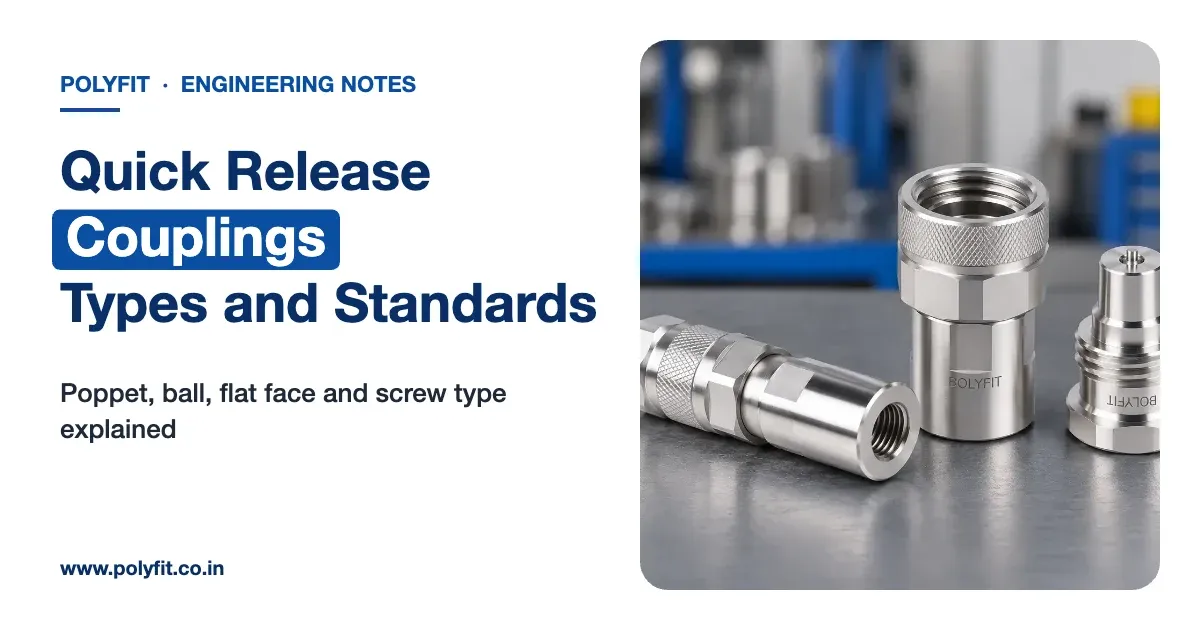
A quick release coupling (QRC), also called a quick coupler, quick disconnect or QD, lets you connect and disconnect a hydraulic line by hand in seconds, without tools and with little or no oil loss. You will find them on tractor implements, excavator attachments, hydraulic tools, test points, mould change systems and portable power packs. Choosing the wrong type, though, leads to oil spills, hard connection, overheating or premature seal failure. This guide explains the types, the standards and a practical selection method.
How a quick release coupling works
Every QRC has two halves:
- Male half (plug, nipple or tip) usually fitted on the hose.
- Female half (socket or body) usually fitted on the machine or tool.
Each half contains a valve that closes automatically when disconnected, so oil stays in the line and dirt stays out. When the halves are pushed or screwed together, the valves open each other and oil flows. A locking mechanism (balls, a sleeve or a thread) holds them together under pressure.
Main types of quick release couplings
Poppet type
The valve is a cone-shaped poppet in each half. Poppet couplings are robust, tolerant of dirt and inexpensive, and they are the most common hydraulic coupling in agriculture and general industry. Most ISO 7241 Series A couplings are poppet type. They lose a small amount of oil when disconnected and let in a little air when connected.
Ball type
The valve is a spring-loaded ball. Ball valves seal well, but the ball sits in the flow path, which gives higher pressure drop. They are often used on lower-flow and older equipment, and in some ISO 7241 Series B designs.
Flat face type
Both halves have flat mating faces, and the valves are flush with the face. When disconnected, there is virtually no spillage and no air inclusion, and the flat face can be wiped clean before connection. Flat face couplings to ISO 16028 are now standard on skid-steer loaders, compact excavators and attachments, and anywhere oil spills or contamination are unacceptable.
Screw type (thread-to-connect)
The halves are joined by a threaded sleeve instead of push-in balls. Screw couplings handle high pressure, pressure spikes and vibration better than push-to-connect types, and many can be connected with residual pressure in the line. They are common on hydraulic breakers, crushers, jacks, rescue tools and high-pressure test equipment.
Other quick couplings
- Air breathing and pneumatic QRCs for compressed air and breathing air lines.
- Claw or Macdonald type quick action couplings for compressed air and water service lines in mining, construction and plants.
- Water blast couplings for high-pressure water jetting.
QRC standards you should ask for
Standard | What it covers | Why it matters |
|---|---|---|
ISO 7241 Series A | Poppet couplings, widely used in agriculture and Europe | Interchangeable with many tractor and implement couplers |
ISO 7241 Series B | Couplings widely used in industrial applications | Different dimensions from Series A, so not interchangeable |
ISO 16028 | Flat face couplings | Interchangeable flat face couplers across brands |
ISO 5675 | Agricultural tractor couplings | Tractor-implement connection |
Asking for a coupling "to ISO 16028" or "ISO 7241-A" is the fastest way to guarantee it will mate with what is already on the machine. Couplings that merely "look the same" are often slightly different and either do not latch or leak.
How to choose a quick release coupling
- Pressure. Check the maximum working pressure of the coupling in the size you need, and allow for pressure spikes. For impulse-heavy duty such as breakers, choose screw type.
- Flow and size. An undersized coupling causes high pressure drop and heat. Check the maker's flow curve at your flow rate, not just the thread size.
- Connection under pressure. If the line may have trapped pressure (for example, from sun-heated oil), select a coupling designed to connect under residual pressure, or add a pressure release.
- Spillage and contamination. For mobile attachments, food or clean environments, choose flat face.
- Interchangeability. Match the standard already used on your fleet.
- Material and plating. Zinc-plated carbon steel suits most hydraulics. Choose stainless steel for corrosive, marine and chemical service.
- Seals. NBR suits mineral oil. Choose FKM (Viton) for higher temperatures and many synthetic fluids, and check compatibility for water-glycol and phosphate ester fluids.
- End connection. Specify the thread on each half: BSP, NPT, JIC, ORFS or metric. Our thread size chart helps you identify them.
Comparison at a glance
Type | Spillage | Pressure drop | Dirt tolerance | High pressure / impulse | Typical use |
|---|---|---|---|---|---|
Poppet | Small | Moderate | High | Good | Agriculture, general hydraulics |
Ball | Small | Higher | Moderate | Moderate | Older and low-flow equipment |
Flat face | Almost none | Low | Excellent (wipeable) | Good | Construction attachments, clean systems |
Screw | Small | Moderate | High | Excellent | Breakers, tools, test, high pressure |
Care tips that make couplings last
- Always fit dust caps on both halves when disconnected.
- Wipe both faces before connecting.
- Relieve pressure before disconnecting wherever possible.
- Never use couplings as a swivel: rotation under load wears the locking balls.
- Replace seals at the first sign of weeping, and replace both halves if the locking balls or sleeve are worn.
Quick release couplings from Polyfit
Polyfit supplies quick release couplings (QRC) in screw type, poppet type, ball type and flat face designs, along with air breathing QRCs, Macdonald type quick action couplings and water blast couplings. Browse the full hydraulic adapters and couplings range, or tell us your pressure, flow, fluid and end threads through Request a quote and we will recommend the right coupling.
From precision components to custom manufacturing, Polyfit delivers solutions tailored to your application and specifications.
Request a quote