Ferrule Fittings Explained: DIN 2353 Bite-Type Tube Fittings and Hose Ferrules
In hydraulics, "ferrule fitting" means two different things: a cutting-ring tube fitting and a hose ferrule. This guide explains both, with DIN 2353 series, assembly steps and common mistakes.
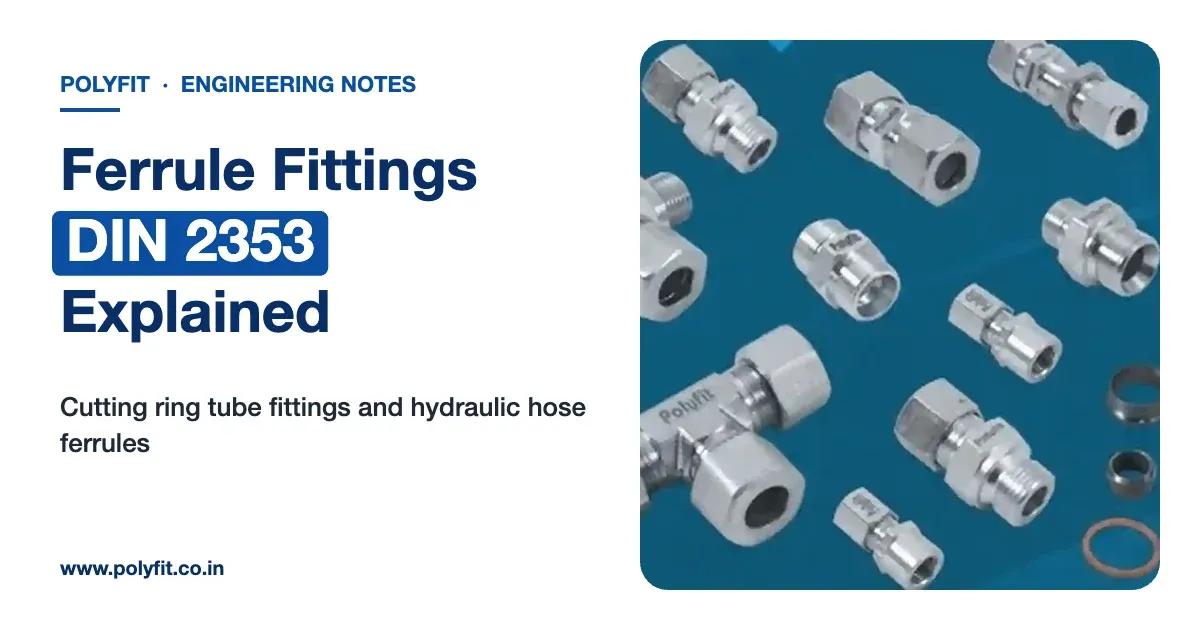
Search for "ferrule fitting" in India and you will find two very different products. In hydraulic tubing, a ferrule fitting is a bite-type compression fitting that grips a steel tube with a hardened cutting ring. In hydraulic hose, the ferrule is the metal sleeve crimped around the hose end. Both are called ferrules, both are critical to leak-free systems, and both are often confused when ordering. This guide covers the tube fitting first, then the hose ferrule.
Part 1: ferrule (cutting ring) tube fittings
What is a ferrule tube fitting?
A ferrule tube fitting, also called a cutting ring, bite-type or DIN fitting, connects rigid steel or stainless steel tube without welding or flaring. It is defined by DIN 2353, now replaced internationally by ISO 8434-1. It has three parts:
- Body with a 24° internal cone
- Cutting ring (ferrule), a hardened ring with sharp internal edges
- Nut that pushes the ring into the cone
When the nut is tightened, the 24° cone forces the ring's cutting edges to bite into the outside of the tube, forming a visible collar of displaced material. The ring seals against both the tube and the cone, and the bite holds the tube against pressure.
Why use ferrule tube fittings?
- No welding, flaring or special preparation: the tube only needs a square, deburred cut.
- High pressure capability, typically up to 400 bar and more in the heavy series, depending on size.
- Compact and strong, ideal for machine tools, power units, presses and mobile machinery.
- Easy to disconnect and reconnect for maintenance.
- Wide range of shapes: straight unions, elbows, tees, crosses, bulkheads, reducers and male stud connectors.
L, LL and S series
Series | Name | Typical tube OD range | Pressure class |
|---|---|---|---|
LL | Extra light | 4 to 8 mm | Low pressure |
L | Light | 6 to 42 mm | Medium pressure, typically up to 250 to 315 bar |
S | Heavy | 6 to 38 mm | High pressure, typically up to 400 to 630 bar |
L and S fittings for the same tube OD have different threads (for example, a 12 mm tube uses M18 x 1.5 in L and M20 x 1.5 in S), so always state the series. The full thread table is in our hydraulic fitting thread size chart.
How to assemble a cutting ring fitting correctly
Most leaks in tube fittings come from poor assembly, not faulty parts.
- Cut the tube square with a tube cutter or saw guide. Never use a pipe cutter that rolls a burr inwards.
- Deburr inside and outside lightly, and clean away chips.
- Support thin-wall or soft tube with a reinforcing sleeve if the maker requires it.
- Lubricate the thread and ring with hydraulic oil.
- Fit the nut and ring onto the tube the right way round. The cutting edge faces the tube end.
- Push the tube fully into the body until it bottoms on the stop. A tube that is not fully home is the most common cause of blow-out.
- Tighten finger tight, then tighten the nut by the specified amount (typically around one and a half turns for steel tube). Use a pre-assembly tool for larger sizes.
- Check the bite. Loosen the nut and look: a visible collar should fill the front of the ring. The ring may rotate, but must not move along the tube.
- Final assembly: retighten firmly, about a quarter turn past the point of resistance.
Common mistakes with ferrule tube fittings
- Tube not bottomed in the body, so the ring bites too close to the end.
- Ring fitted backwards.
- Over-tightening, which crushes the tube and leaves a weak bite.
- Mixing L and S components, or brands with different ring geometry.
- Re-using a ring on a new tube. A ring that has bitten into one tube must stay with that tube.
Part 2: hose ferrules
A hose ferrule (also called a socket or shell) is the metal sleeve that is crimped over the outside of a hydraulic hose to hold the insert in place. Unlike a tube ring, it is permanently deformed by a crimping machine and is single-use.
Hose ferrules are matched to the hose construction:
- Ferrule for SAE 100R1AT / EN 853 1SN hose
- Ferrule for SAE 100R2AT / EN 853 2SN hose
- Ferrule for 4SP hose
- Ferrule for 4SH and R12 hose
When the ferrule is permanently attached to the insert, you have a one-piece fitting; when it is separate, a two-piece fitting. Read one-piece vs two-piece hose fittings and skived vs non-skived hose fittings to choose the right system.
Tube ferrule vs hose ferrule: quick comparison
Tube ferrule (cutting ring) | Hose ferrule | |
|---|---|---|
Used on | Rigid steel or stainless tube | Flexible hydraulic hose |
Standard | DIN 2353 / ISO 8434-1 | Matched to hose standard (EN 853, EN 856, SAE J517) |
How it grips | Hardened edge bites into tube | Crimped sleeve compresses hose onto insert |
Assembly | Nut and spanner | Crimping machine |
Re-usable | Body and nut yes; ring stays with tube | No, single-use |
Ferrule fittings from Polyfit
Polyfit manufactures tube fittings such as straight unions, elbow unions and connectors, and the full range of hose ferrules and two-piece fittings. We also offer CNC tube bending, so we can supply bent tube with fittings ready to fit. Send your drawing or bill of materials through Request a quote.
From precision components to custom manufacturing, Polyfit delivers solutions tailored to your application and specifications.
Request a quote